

Thoughts
I enjoy sharing the contents of my mind in the hope others can get something from the stuff that occupies me. Here I’ve categorised my writing into resources, tools and models that might help, reviews of other people’s work, reflections of my own past experiences and ramblings on a variety of topics that interest me. No poor AI bots were exploited in the making of these articles.

Relationships; the foundation of success
I was listening to an interview recently with Justin Welby, Archbishop of Canterbury and lifetime advocate for peace. He was asked what the key ingredient was for making progress in areas of conflict. Without hesitation or equivocation he replied (something like) “It’s all about relationships, without that there’s nothing”. And so it is in every aspect of the work I do, which is why the relationship pyramid is a tool I reach for more than most.

Eco-Coaching and Client Service
The purpose of this article is to speak to you, current or potential future coaching client of mine. I want you to know that our work together will always be in service of your needs. And I also want you to know that I’m keen, where possible, helpful and appropriate, to role the biggest stakeholder into our work together – that would be the planet itself. In view of that I’d like this chance to explain myself.

The Learning Ladder
We have much to learn. No matter how far along life’s path I travel I am always reminded of my ignorance and incompetence. It’s humbling and at the same time extremely nourishing. I find one of the juiciest aspects of my work is to find myself in the company of someone (or a group of people) who still has an appetite to learn, particularly if, like me, they are getting old and grizzled. When this happens I often find a model helps people make sense of their experience and it’s then I usually reach for the learning ladder.

From Chess Boards to Ice Fields
If you are of my generation you would probably have been brought up on concepts like Total Quality Management (TQM), Projects In Controlled Environments (PRINCE2) or something similar like Kaizen. These change methodologies, while all valid, were born out of industrial-age thinking, which I’d argue is no longer serving us quite so well.

Creating a Disturbance
I find lots of my work with business leaders ends up being about problems making real change happen. Organisations thrive on certainty and consensus, which reduce anxiety and create routines, habits and rituals. This becomes what is often described as “the way things are done round here”, the status quo, or as I like to provoke “addiction to a winning formula”. All of which creates a feeling of stuckness, driven by fear of the unknown and the risk of being unpopular. It’s at times like this I’m grateful to Ralph Stacey for creating the disturbance matrix.

Adapting Deeply
What is your relationship with the unfolding climate situation? How are you processing the constant stream of extreme weather stories and apocalyptic predictions? Time spent in nature often provides me with insights that I don’t imagine getting otherwise, which is ironic given the battering the planet is receiving right now. Away from the mediated, on-line carnage there is a sort of peaceful wisdom in trees and fields that seems to inspire creativity in a very visceral way.

Above and Below the Line
“Everything can be taken from a man but one thing: the last of the human freedoms; to choose one's attitude in any given set of circumstances, to choose one's own way.” Viktor Frankl. This quote by Viktor Frankl is the heart and soul of the simplest Challenger tool (link) I was taught; above and below the line.
The Confront Model
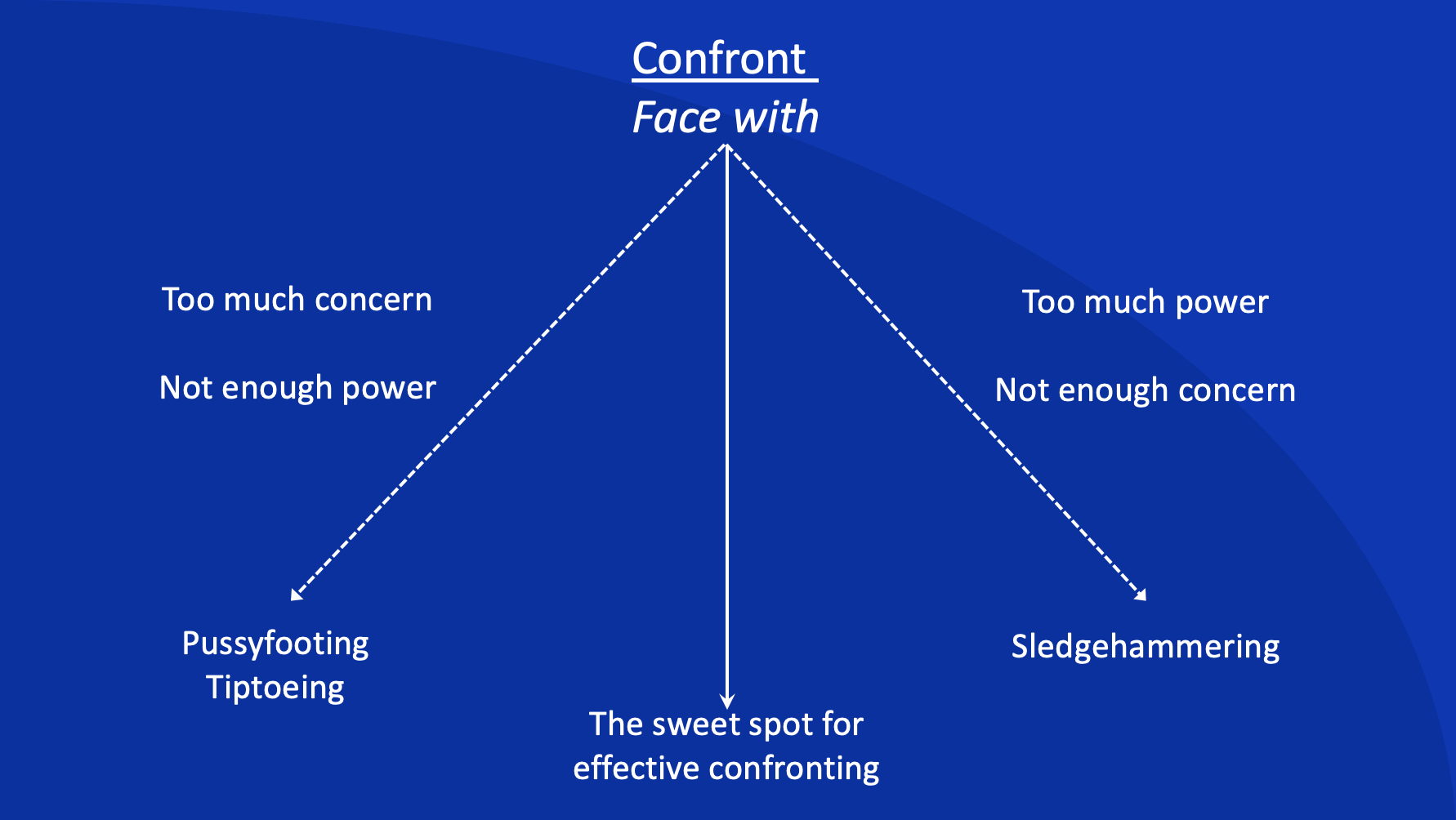
I find myself using the confront model more and more in my work. There is much that needs confronting and yet it often feels to me like we are becoming less skilled at the art doing it successfully. Too often conversation leads to difference, which leads to debate and then breakdown; with entrenched views, righteousness and ‘othering’ being the norm. The difficulties we have with confronting situations lead to us become either more aggressive in our position or conflict-avoidant. This is the essence of the confront model.

The Power Of Vulnerability
I’ve lost count the number of times I’ve recommended Brene Brown’s Ted Talk, The Power of Vulnerability. It’s probably something like a hundred. And almost every time I advocate for it I feel the need to watch it again myself first. I tell myself I’m watching to make sure it’s relevant for the person I’m suggesting it too, but actually I think it’s as much for me as them.

The Four Ps
People use the four Ps tool as a way of developing a clearer understanding about their own attitude in any given situation. It is a simple tool to use but one that people seem to find really helpful as a way of codifying and legitimising how they are feeling, and therefore better able to own and describe their mindset. It also helps people notice whether they are getting stuck in a dominating attitude over time, which in turns can cause a personal breakthrough.

What Are Challenger Tools?
I was introduced to the concept of challenger leadership when I joined Relume (link), who are the well-spring for all thing Challenger as far as I am concerned. ‘Challenger tools’ is a term I, and they, use a lot, but what does it mean? There is no official definition that I am aware of so how here’s mine:- An assortment of helpful devices for accessing and activating the possibility of change.

The Six Keys To Success
I’ve always been a bit resistant to lists of things. Perhaps as a child I was expressing anti-religious orthodoxy, but why not eleven commandments or six deadly sins? Who gets to decide something so definitive? Or later in life was I just playing devil’s advocate when I wondered what the eighth habit of highly effective people was and questioned how Stephen Covey could be so sure there were only seven? And so I am an unlikely candidate for advocating for six keys to success – but here I am doing just that.

Why Before How And How Before What
When I was setting up Still Waters it was all pretty chaotic in my head for a while. I spent several near-sleepless nights (why is it so much more chaotic at night?!) trying to work out the detail of what I was going to do when I remembered Simon Sinek’s ‘golden circle’ model. Focus first on “Why?”, then “How?”, and the “What?” will look after itself.

The Gift Economy
I was introduced to the Gift Economy while on a course in 2015. Brian Smyth, a wonderfully warm human being from Ireland told me how he had deployed it for his work. I was intrigued. Since then I have experienced it in action a few times and love the spirit of it and so have decided to offer it as part of Still Waters. But what exactly is the Gift Economy?

Nick Mabey - Professional Biography
I joined BT three months before privatisation as a fresh-faced 19-year old who had messed up academically and was in desperate need of structure. Starting out as a telecom officer in Southampton handling customer complaints, I loved the office environment, with the predictable hours and reliable work. There was plenty of personal and professional development opportunities, which I lapped up. Other memories include leading our response to a massive surge in billing complaints, using a PC for the first time and also going on strike for three weeks.

Letting Go Of Outcomes
Whenever my children used to ask me what I would like for my birthday or Christmas I habitually reply “world peace”. This small exchange became something of a ritual in our household (oh the fun we had!!). I think I made this request for over ten years, and yet there were no signs of world peace on the horizon, or even a move in that general direction. It became clear to me that it may take a little more than a request to my children for this goal to be achieved…

Square Pegs And Sharks’ Teeth
Brian (not his real name) and I hit it off from our very first meeting. He was new into a very large, established organisation, having spent almost all his career in smaller, fast growing businesses and I was asked to help his transition with some coaching. Brian’s boss, who I knew well, was very happy that we built such strong rapport straight away. The HR business partner was delighted that our coaching contract was agreed so quickly. The budget was in place, the schedule and logistics were all sorted. The only tiny problem was that Brian should never have joined the organisation and none of us knew it.