
Group Coaching
I’ve been a group coach a long time but have never really thought about it until I was asked to write this for a book. I don’t call myself a group coach and, to be honest, was not really aware of the term until fairly recently. I’ve been doing this work much longer than I realised. In other words I am ascribing theory retrospectively to practice. All of which feels like history repeating itself.

I started coaching individuals round the turn of the millennium, except at the time I wasn’t really aware of it, and certainly didn’t call it coaching. It began with helping people to give more effective presentations (I later discovered there was a thing called speaker coaching – who knew?), which led on to helping leaders deal with the challenges of leadership (executive coaching as it turns out – a term I’ve never liked). After about ten years of instinctive, uneducated work and a growing realisation that I was being regarded as a professional coach I decided to get some education. A masters degree at Metanoia in West London taught me many things, including much needed theory to underpin my hitherto unconscious practice. At this time I also discovered that I was in fact a team coach too, of many years standing, I just hadn’t realised it.
I was encouraged to develop a model during my masters study. There I discovered I was an integrative coach with a humanistic psycho-dynamic instinct, which is a complicated way of saying I believe in people, am curious about how their minds work and apply whatever method is going to be most helpful to them. I do this with:
Listening. The king of coaching skills, and not one that comes naturally to me. Global listening, as described by Laura Whitworth, is the gold standard I aspire to.
Questions. Creative precise questioning, asked with curiosity more than judgement, is at the heart of the work. This I do find easier.
Grace. John Heron’s Helping the Client and Carl Rogers On Becoming a Person provide language for the belief I have in my clients’ potential and the optimistic, positive regard I hold them in
Mirror. Beyond these three universal elements I see my role as to help my clients see themselves, fully and kindly.
Tools. I use a range of psychological tools and resources, gathered over the years, to stimulate or catalyse learning.
Provocation. Last but not least coaching is about change and change often needs a prod. I instinctively challenge and play devil’s advocate. I also bring tools, mostly psychological devices, to provoke.
I offer this preamble to help provide some context for what follows. My group coaching practice is built on the same foundations as my work with individuals and teams. My aim here is to focus on the distinct features of group coaching as I know it, and exclude the generalities of good coaching practice.
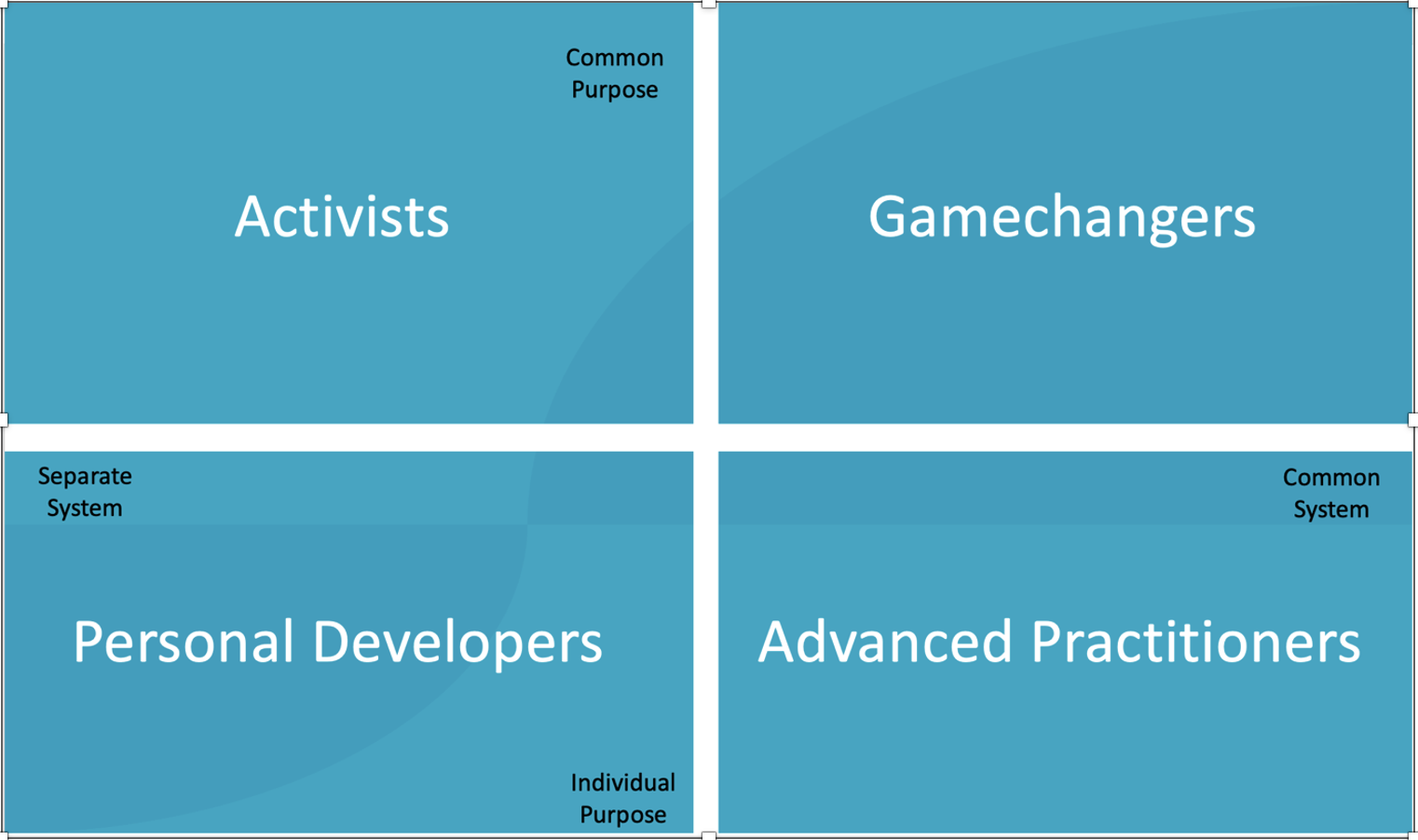
How My Group Coaching Breaks Down
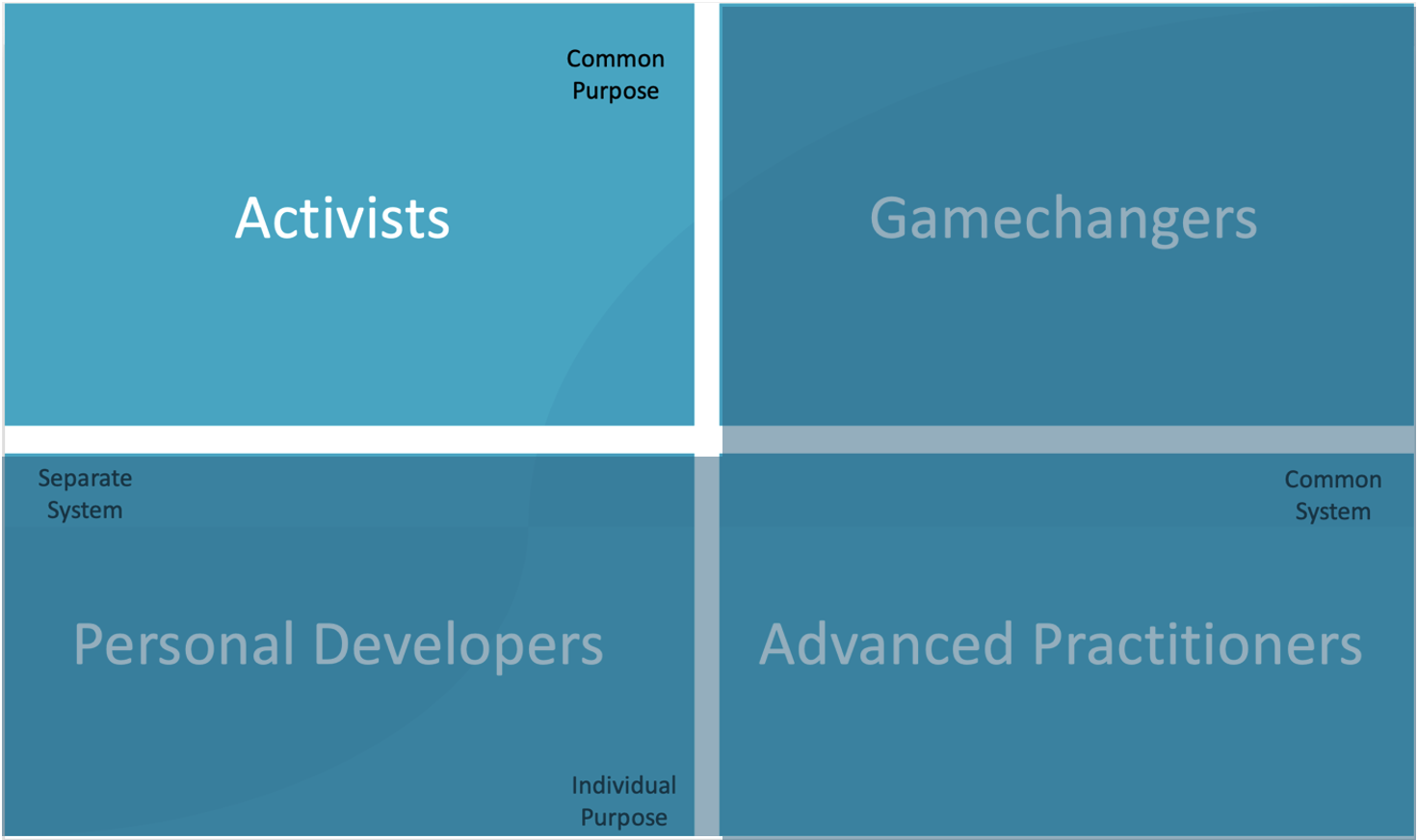
I’ve created a diagram to help break down my experience of group coaching into more manageable chunks. It’s not some random creation; I’ve realised that the distinguishing features of this work concern the groups themselves and their aims. Are they from the same organisation and do they know each other? What are they hoping to achieve and does that very from person to person
System axis
When I talk about common systems I am generally meaning the professional organisation that has asked me to coach. Most of my work is sponsored by a central decision maker in a company, who has decided there is some value in commissioning work with group coaching at its heart. I do this more often than coaching groups from separate systems, but increasingly I find myself working with groups who are more disparate. It could be a bunch of freelancers taking part in some learning together, or a collection of random folk united in some endeavour.
Purpose Axis
The concept of purpose can be a tricky one. I could have used objective perhaps but that seems a little dry and also presumptuous. When I talk about common purpose in the diagram it is because the group have come together in order to cause something collectively, like keeping a library open or saving the planet. Individual purpose, on the other hand, implies the participants in a group are there, at least at the start, for their own reasons, such as learning to meditate or reconnect with nature.
Having produced this model retrospectively for this chapter, I realise it will be of help to me going forward in understanding the ambition and orientation for future assignments. I also notice that my history in group coaching goes back further with common systems than separate ones. I have a feeling that my own practice is heading west and north on the following diagram.
To save you the bother of working it out, the shortcomings in this model are about interconnectedness and perspective. If you widen your focus enough we are all part of a common system, whether you call it the global economy, society, homo sapiens or even the living world. The same applies with purpose, at least in my work. While the headline objectives might at first seem quite different, all the groups I coach have at the heart a desire for change, and an emerging recognition that change starts with them. With caveats now firmly in place I can now venture freely through each quadrant.
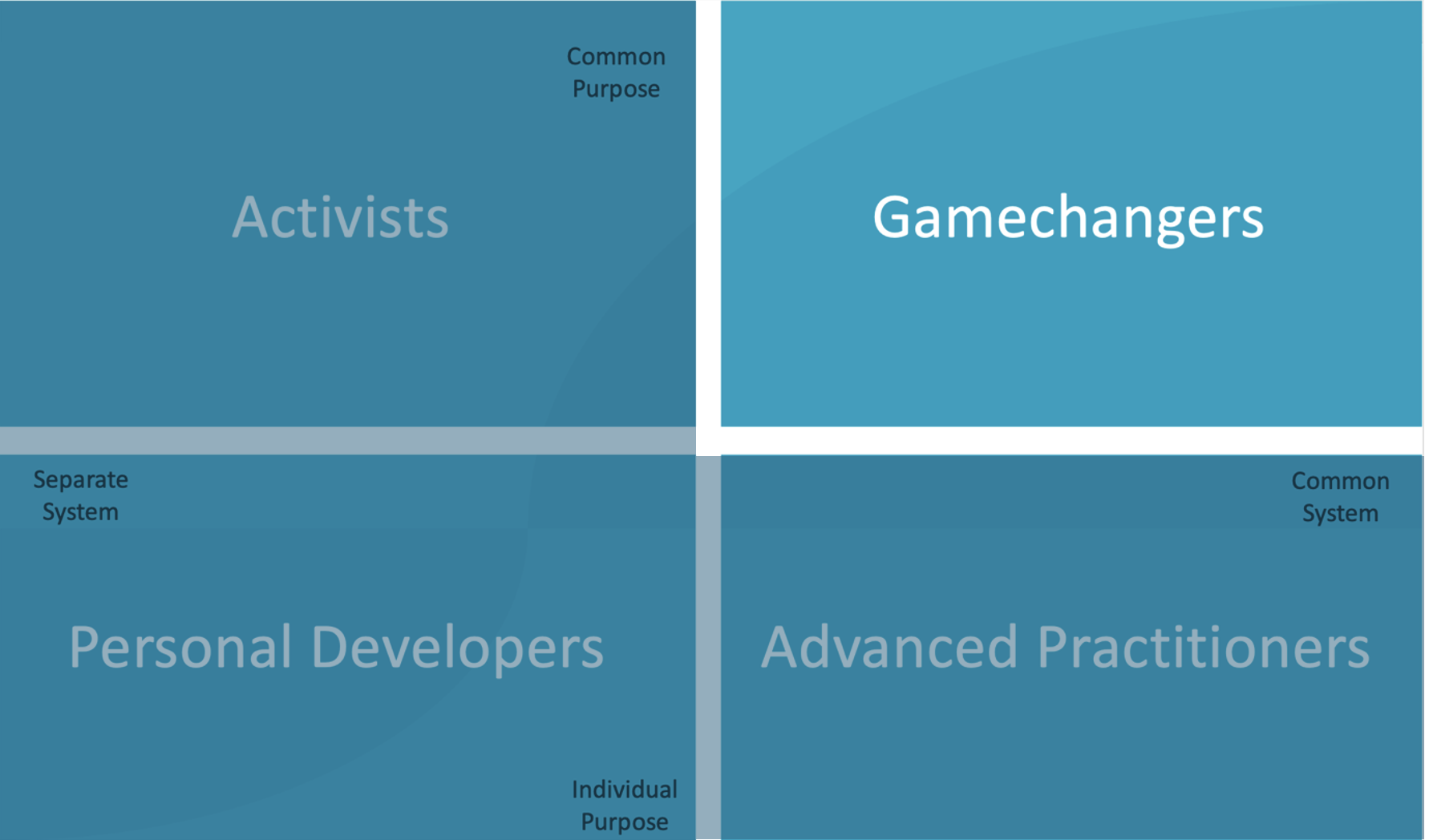
Gamechangers
I’ve done quite a lot of work with organisations who get stuck, in terms of being able to bring about meaningful change. The dominant culture is designed to maintain the existing course and struggles to alter direction, a bit like a wagon travelling along deep tracks. Someone decides it will be good to assemble a group of talent (code for high performing leaders frustrated by the way things are) and get them to solve the problem of system addiction to a winning formula. Welcome to our gamechangers.
A word on team coaching before we start. I’ve chosen to discount intact leadership teams from my thinking. By intact team I mean a group of people in an organisation who would self-identify within a hierarchy as a team. They may not act like a team, and that is often where my work sits, but the system paying me sees them as a team. Team coaching is, to my mind at least, a much more established and easily recognised professional service. It usually involves some help achieving a set of business goals, generally by improving the relational dynamics within the team. Much has been written about it and I don’t intend adding to that here, save to say that I guess it would belong in the top right quadrant of my diagram. If you want more on team development I would recommend Patrick Lencioni’s Five Dysfunctions of a Team or Peter Hawkins’ Leadership Team Coaching: Developing Collective Transformational Leadership.
The term ‘gamechangers’ was actually used by a client to describe some group coaching work I was asked to do. A pharmaceutical company of about one hundred employees had decided it needed to develop the culture of the organisation as it moved out of the shadow of a once-controlling parent company. They realised a conventional approach of working with intact teams through the hierarchy was just the sort of thing their owners would do and so they chose to go another route. They selected 10 people from across the functions and hierarchy and asked me to coach them to be gamechangers.
The brief was just clear enough, but the sponsors, in a progressive move, wanted the group to have a level of self-determination about their coaching objectives. As group coach I was asked to bring some tools to help the group navigate their way and then be at their side on the journey. What we did know, because everyone thought it was a good idea, was that we would start with an immersive day and a half off-site, and something – detail unknown – to provide ongoing coaching support over the following few months.
The first morning was spent creating a psychologically safe space for the group to work. They knew each other to varying degrees, which meant in some cases introductions and in others noticing existing relational dynamics. In the afternoon we moved on to explore common purpose using a couple of tools I had introduced to produce shape, colour and meaning. They also spent time involved in conversations about their aspirations for their company. The second morning was spent designing and agreeing how they were going to move forward.
We ended up having regular coaching calls on-line for the next six months. At these meetings we got into a rhythm of re-connecting, sharing progress and learning, and (re-) committing to action. I am always conscious of encouraging self-reliance and minimising coach dependence and here my role as group coach became deliberately and increasingly light touch as time went on. Attendance was good at first, patchy in places, and eventually ended with a whimper rather than a bang. That’s not to say that the group was not effective in its goals, but perhaps a lesson for me in how to manage endings better.
What I learned most from this experience is the power that can be generated within groups when they are coached in this way. By power a mean a strong bond between participants, a mighty sense of common purpose and enough dynamic energy to make real change. The group united around both a sense of collective endeavour and also the perseverance needed to effect change. To what extent was this a feature of the coaching, rather than the make-up of the group or the nature of the task? As ever in this line of work, the answer is not clear.
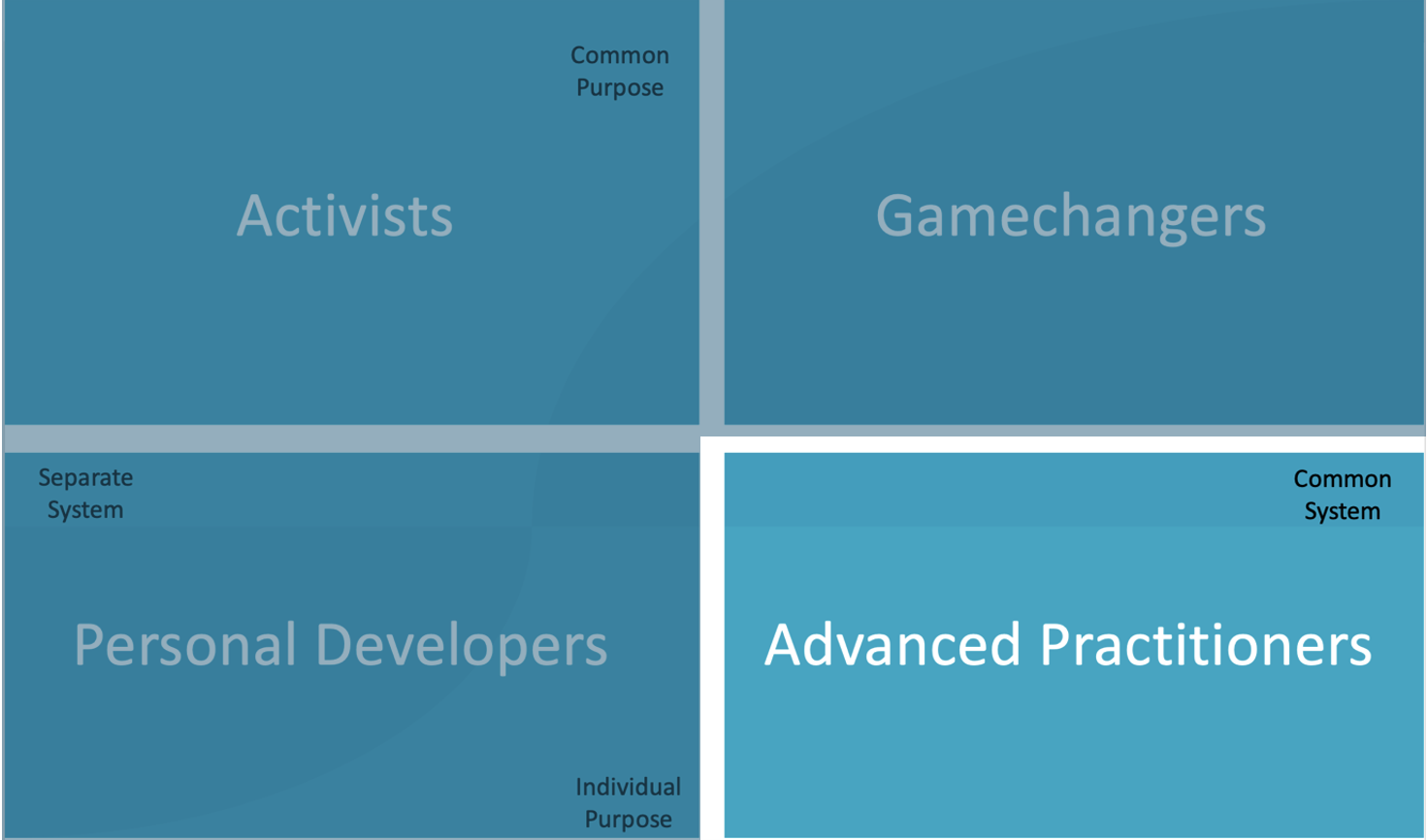
Advanced Practitioners
In the quadrant of common system and individual purpose there is a risk of conflating coaching with training. Over the years I have been asked to deliver training to groups in a number of topics, but I do not see this as coaching (at least for the purposes of this writing). Here I am discerning the coaching of a group of people to become more advanced practitioners as being light on content and more heavily focused on exploration and enquiry. I hope the following example demonstrates this.
We (I did most of this work two-handed with a fellow coach) were asked to help a group of relatively senior leaders in a healthcare organisation develop their leadership capability. There were several sequential cohorts for this work, mixed by function, in order to clearly signpost this as individual rather than team development. The brief was to help the group discover individual learning goals and coach them collectively on these.
We decided to start by having individual conversations with each group member. The objectives of these were to develop trust, establish learning preferences, introduce the group work and identify, albeit it tentatively and with curiosity, some possible learning goals. I had used the approach before (and since) and it almost always provides a strong foundation for group work, particularly when there are systemic factors to be discussed. Because inevitably, even though the coaching was ostensibly individually focused, the group all worked for the same company and their development was entwined within the culture of the business.
After the one-to-ones, and a personal write up, the group met for a day off-site to begin their collective endeavour. We called these ‘discovery days’ because the work was primarily focused on identifying individual development goals and learning a couple of tools to help in the process. They also discovered more about themselves, each other and the wider organisation by spending such a long period in structured conversation. The coaching on the discovery days was individual, in pairs and as a whole group. We spent quite a bit of time contracting for psychological safety and offered ‘just enough’ structure to foster phenomenological learning.
We then offered three on-line learning sets, inspired by the work of Reg Revons, lasting a day each time. At these, the group were encouraged to reflect on learning, give each other feedback and commit to the next cycle of action. The coaching we offered during these days was a mixture of maintaining the space for the work to take place and offering our own input to the learning.
There were a couple of lessons for me as a group coach. Firstly, not to underestimate the power of peer coaching and learning. In a couple of the cohorts the group consisted of people doing similar jobs in different parts of the business, without any regular, meaningful interaction. By creating a safe psychological space where people felt they could disclose their vulnerability without judgment and offer very direct feedback without consequences, we effectively set the group free to coach each other. Our ‘professional’ coaching became extremely light touch very quickly and the group flourished in their individual development.
The second learning is less rosy. In one later cohort in particular the group didn’t fully engage with a commitment to their own development during the discovery day. This had an impact on the quality and focus of their work in the learning sets, which consequently were experienced as flat and repetitive by some members of the group. As a coach I had perhaps become unconsciously reliant on the previously-successful process and not paid enough attention to what was arising in the moment. The lesson was clear, the support structure for group coaching needs to be in service to the needs of the group and never the other way round. It’s painful learning and I hope that if this had been individual or team coaching I would have spotted it and adjusted accordingly.
Hybrid of Game Changers and Advanced Practitioners
I’ve got a third story from the common system side of the diagram, which is a combination of the previous two. The client, a telecommunications company, wanted both individual leadership development and systemic change. The groups were chosen as described in the pharmaceutical company and the work was configured in a very similar way to the that of the healthcare company, the only real difference being that the group worked both on individual goals and also collaborated on some collective ones. This created a much stronger link between personal learning and systemic impact. The reason for sharing the story is that it offered up two more pieces of learning for prospective group coaches.
Firstly, the other point of difference between this work and the healthcare story was the amount of individual coaching we were able to offer in among the group coaching. I know from experience that working one to one alongside team coaching can make a powerful impact, and the same was true with the groups in this case. There are some challenges to this, the risk to boundaries in terms of confidentiality and collusion, but the benefits in this case strengthened both the individual development and the collective impact.
Secondly, put simply, the organisation got bored with the work while it was ongoing, the goals lost traction and the group was left to find its way back from gamechangers to game players. We knew this was an existing pattern in the business – new development initiatives losing their flavour of the month status in the fast flow of change. So perhaps the learning is to watch out for this, and if possible to weave it into the work.
Small Scale Systemic Group Coaching
These three stories combine to give a certain picture of big groups doing personal and systemic development work together while being coached by me. It doesn’t have to be that way in systemic group coaching, where pulling together a small group of people in service of individual or collective goals is actually far more common, albeit the stories are less complex.
Two brief examples:
I often find myself coaching groups of people in a company who have been selected from across the business to organise something together, like a conference or an initiative. Normally there’s four or five people for three to four sessions over a couple of months and the work is gamechangers with a very small g. Nonetheless a person-centred approach to coaching, where the group retain owners and architects of the solution, is key to success.
Sometimes the training work I do in presentation skills leads to some group coaching. If I am ever asked to coach someone on their communication skills I almost always recommend this is done as a small group. Not only does it represent better value for money, more importantly it provides an audience for the presenter to talk to. I think four is the best number for this sort of group coaching, which often involves setting up a practice ground where the group try out things on each other and get feedback. My role as coach mostly involves holding the space, organising the time and technology, joining in with the feedback and perhaps occasionally offering a judicious piece of ‘expert’ input.
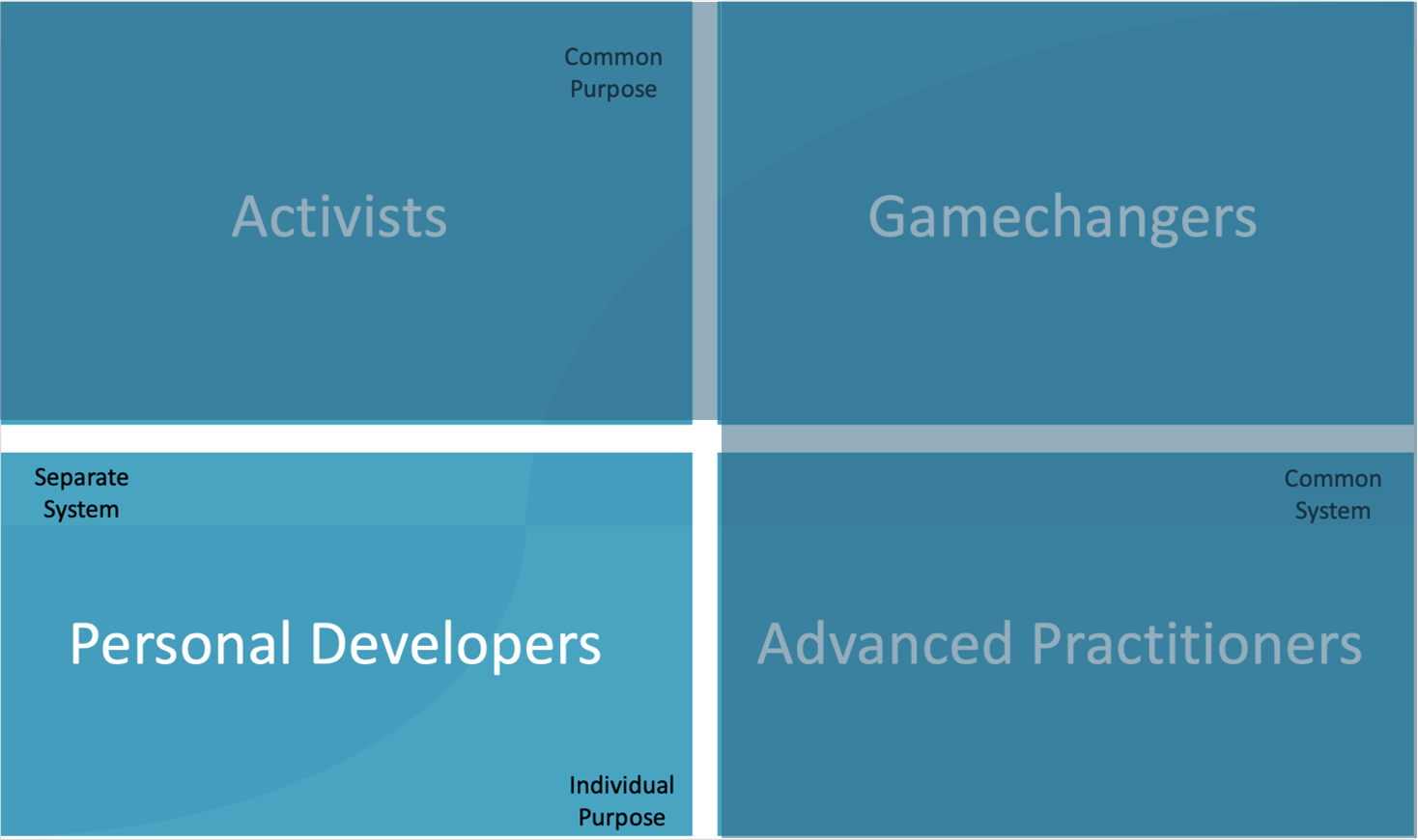
Personal Developers
The practice of coaching groups who are not part of an immediate and recognisable system happens in a myriad of ways for me. So it’s hard to be certain of the applicability of my experience, either to me or you. With that in mind, and to keep the clockwise motion going, I’ll start with personal developers.
The market for personal development interventions is huge, diverse and growing. A seemingly endless array of courses, programs, events and general happenings is offering ways to improve health, wealth, relationships, spirituality, effectiveness, performance and happiness (what did I miss?). I’ve taken part in plenty of these as a participant and never really thought of myself as being an active practitioner. Coaching groups in this domain has kind of snuck up on me; I’m not sure how, and so am just going to offer a couple of stories to hopefully shed some light.
About 14 years ago I was taught mindfulness meditation, and immediately noticed it helped improve my sleep. Within a year my teacher, a fellow student and I had decided to set up a social enterprise to teach others how and why to meditate. As student-turned-teacher I was on a steep learning curve, but the territory was new and fertile (back in the days before mindfulness became mainstream) and I took to it. We started to offer day-long and weekend retreats where we would teach the theory and practice of mindfulness in a very immersive, experiential way. Bear with me, this is all a prelude to coaching.
As time went on, our clients wanted to go further, and the work moved from teaching to coaching (I didn’t call it this at the time but can see it now). Groups would assemble, mostly strangers but increasingly people who had met on previous retreats or who had brought friends. Their coaching goals (again not the language we used) were about deepening, strengthening or simply exploring their practice. Our work became more complex, involving individual focus within a group context. Mindfulness practice focuses relentlessly on the individual experience, but it also has pro-social core. Group coaching of a topic like this was rich.
My learning from this story is about playing with the border between teaching and coaching. Timothy Gallwey’s seminal work, The Inner Game of Tennis, helps here by placing the teaching mandate squarely in the hands of the learner; this change then enabling the ‘teacher’ to adopt a more coaching approach. Gallwey’s work was a key text in helping establish the idea of coaching outside of sport (yes, even though his topic is tennis). His writing helped me understand, perhaps more than any other book, what I was meant to be doing.
My second personal developer story started with a conversation about what the future role of men might be in an increasingly ‘female’ (Western) society. By female we were talking about the rise of qualities such as compassion, collaboration, compromise and nurturing, and the relative decline of more ‘male’ qualities such as confrontation and aggression. In a world without predators to fight, wars to be fought (sadly not as it turned out) and dinners to be hunted for, what is the point of a man? That was about the gist of it and our conversation led to an offer to run a men’s retreat in nature.
We convened for three days together. Those who came could not be classified in any other way other than as men with some curiosity about the topic. I built an agenda with lots of space for physical activity, communing with the trees, silence and fires. The coaching of this group flowed in and around all this. It involved big existential open questions, deep listening and lots of time and patience. The experience was moving and felt meaningful, and I’ve often found its insights to be helpful.
I was a coach and also a participant in this retreat. That didn’t work totally and I learned that participant-coach roles need some particular attention if they are being considered. At its best it brings a first-person enquiry to the coaching provocations, on the other hand it can involve performing two roles badly.
The power of the coaching work was enhanced by what was happening beyond it. The woodland setting played a key role, as did some of the other activities. It’s a package, group coaching was only perhaps 25% of the time and 40% of the benefit. I have since run a number of group coaching retreats in nature, similarly, constructed, and they serve as a constant reminder of the importance of symbols, rituals and context. Laurence Barrett’s A Jungian Approach to Coaching is a helpful resource for coaching generally and also includes a chapter on group coaching specifically.
Activists
This is about working with groups who have come together from disparate places to achieve a common goal. I realise this last box is where I have most opinion and least experience. Perhaps it points the way to my group coaching practice in the future? I certainly like that idea but am not yet sure how I might manifest it. I’ve been inspired by Hetty Einzig’s The Future Coaching which challenges coaches to be more active and co-creating around the change agenda being proposed by the client, to be more of like activists themselves if you like. This poses lots of questions for the foundations practice and also where I choose to work.
Unpacking some thoughts first, the concept of social movements has been around since the dawn of organised societies. The idea of groups coalescing around beliefs and objectives is not new, but social media, and the whole connected world concept, has thrust activism forward into the limelight. What is unknown to me is how well coached activist groups are and what might be the benefits of doing so? Having someone working in a position of trust, focused solely on the efficacy of the group in relation to its aims is an idea I find fascinating. Who wouldn’t have wanted to coach the gunpowder plot group? Greenham women? Personally working for the Korean farmers who unsuccessfully took on the G20 over globalisation and its impact on their livelihoods would really have appealed.
Compared to the other quadrants, my experience in this area is small and recent. One that springs to mind is a group of sustainability leadership coaches who came together, in nature, to enquire into their professional and personal relationship with the climate crisis. As with the men’s group, nature played a figural role here, to the extent that the trees became something of a third group coach.
We ran the event over about 28 hours, most of which was spent (when not eating and sleeping) in a immersive enquiry.
The learning was similar to the first two points described with the men’s group. On top of that I would add that he work was part individual, part systemic. Some of the insights were taken back to the client organisation that the group was serving. Others remained in the notebooks of individuals. Is it possible to work on common cause without individual learning? And is it ever desirable? Probably no an no, but these a questions more for my model than the groups I coach.
Secondly, group coaching can really benefit from slowing things right down, particularly where depth of enquiry is required. An equation would be something like… half the pace = twice the depth. The physical environment certainly plays a part here, but there’s a tension between the urgency in the idea of activism and the wisdom of thoughtful reflection.
I also noticed something about this particular client group. Coaching a group of coaches is both a blessing and a curse. A blessing from the point of view of the participants ability to peer coach and learn. A curse from the point of view of people potentially taking care of others work more than focusing on their own.
My second example is ongoing and in its early stages. I am including it here because it offers a chance to share my thinking in the present tense. How it evolves is a mystery at this stage. The other reason for choosing this example is that I am a member of this group and not there as a commissioned coach. In fact, the group don’t yet know I am a group coach nor that (in my opinion) they are in need of coaching if they are to be effective. For confidentiality reasons I am not going to be able to offer any more details of the activity and will have to deal in generalities to get my point across – so bear with me.
I’ve been asked to join a national forum with accountability for steering national policy. Fellow members of this group – there’s fourteen of us – have been similarly asked. The request, and organisation of the forum, have come from a central authority. We’ve just started meeting and I have been a little dismayed at the quality of our conversation so far. I think we are unlikely to achieve our collective aim, particularly as we haven’t yet worked out what it is. This is a group of activists in need of a group coach! I’m going to have to either volunteer myself, carry out the work under cover, make a request for a group coach, or give up. I’m still working out what’s the best option. The benefits of a group coach in this scenario are crystal clear to me:
Be supported by a professional who can manage structure and boundaries, looking after psychological safety and conversation efficacy.
Get more objective provocation from a group coaching expert who is not invested in our cause but resonance with it.
Allow us to focus on the topic fully without having to worry about process.
Mediate, where necessary, between different points of view to facilitate progress.
Someone who can hold us to account for the agreement and then successful delivery of our collective goals.
Help us understand our own contribution to the group dynamic and progress, by holding up a mirror.
While coaching steering groups in the not for profit sector is no longer new in the industry, it is something that is not often talked about in the coaching communities I am part of. Inadvertently here I may have created my own business case for group coaching for social impact, which is an emerging field. This could be the basis for many future propositions to come ss aspiring group coaches seek to up their contribution to social change.
Guiding principles
In writing this contribution, It occurs to me that, regardless of which quadrant I am focused on, there are some guiding principles that I apparently hold dear for all group coaching.
Create and protect a safe psychological space for the work. As with all coaching work, progress requires trust in the process and participants.
Establish and champion the coaching goals. Groups can get very lost in the richness and complexity of the work. A coach can maintain a view of the horizon even while in the deepest weeds.
Facilitate collaboration and peer learning. The group are itself a resource for learning; utilising individual and collective experience, learning, strength and failures is both insightful and nourishing.
Bring you self appropriately to the work. As a coach our heritage is partly from the from the detached therapy chair. As I’ve mentioned, Hetti Einzig’s book The Future of Coaching, encourages much more skin in the game from coaches in relation to the work.
Be service-hearted. Group coaching should never be about me or my ego. Being able to contribute fully and wholeheartedly while remaining in service of the group and its goals, is foundational to good practice.
Challenge the group to make the most of the work. The group can easily get lost in its identity, its internal dynamics or over/under stimulation.
Discourage dependency. This is the group’s work not yours. If the group rely on their coach for their ongoing existence then something has gone wrong.
Manage endings. Groups come and they go. Membership can be a moving feast, goalposts shift. Coaching is archetypally a time-bounded service, and this is a helpful discipline to bring to bear to group coaching to ensure strong clear endings.
Points of Reflection
Being asked to write this chapter has revealed much to me about my group coaching practice. I’ve appreciated the chance to bring into consciousness some previously instinctive choices and responses. I realise my thinking is still developing and my writing not definitive. I’m left wondering how this may evolve for me personally.
More broadly I am strengthened in my belief that coaching groups is needed in a world that is grappling with how to effect change in a complex, uncertain world. This field demands more exploration and I hope my chapter, and this book, contributes to that usefully and practically.