
Regenerative Mindsets
I never need much of an excuse to write about mindsets. It’s a topic that fascinates me and ended up being the north star for my journey through work (even though I couldn’t see it for much of the time). Recently a training event at Hazel Hill Wood provided a wonderful opportunity to dive deep into ‘regenerative mindsets’, an idea that had me as excited as my dog gets when my children visit.
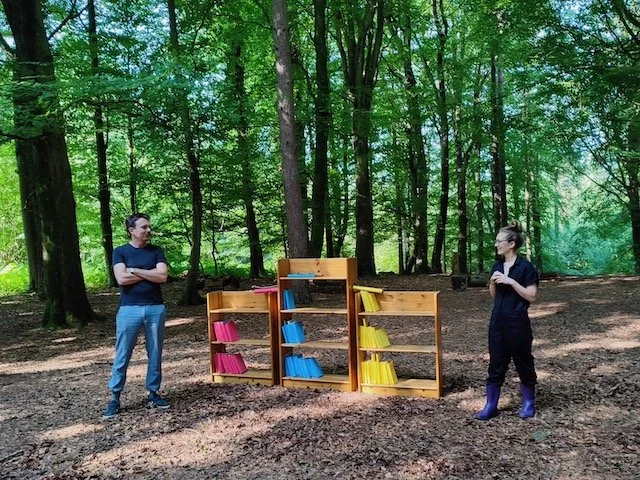
The training was for staff and trustees of Hazel Hill Trust, and was run, rather wonderfully, by Oli Broadbent and Ellie Osborne from Constructivist Ltd, pathfinders for the regenerative design movement in the UK. Oli also happens to be chair of the trustees and this training was an early step on the integration of their work with that of the charity.
Back to the mindsets – spoiler alert – there are three. It turns out there could be two, or four or more (the mindsets are a constructivist construction). But for this work, and in the words of De La Soul, three was the magic number. Before diving in, let me make a pitch for the benefit of a set of mindsets like this (and see my article on six keys to success as proof of my fan boy status):
They help with sensemaking, offering a sheep pen in which our wandering thoughts can be contained
They act as a stimulus, providing creative input to thinking processes
They offer a common language for groups of people who are looking to collaborate more effectively.
They are toys to play with (and as such not to be taken too seriously – they are not gospel)
The three regenerative mindsets were positioned as moving from…to…, as follows:
From separation to interdependence
From scarcity to abundance
From control to emergence
Oli’s book has more description, but part of the fun is to find your own meaning in the words, particularly in conversation with others you are using them with. If that sounds like a cop out, I’ll share my own relationship in the next paragraph– but feel free to skip that bit)
I’m a big fan of interdependence, having needed therapy to convince myself I do actually belong in this complex connected system we call life. Charles Eisenstein called it interbeing in a book I loved and I’ve also got lost in it trying to understand quantum theory. For me abundance gets translated into gratitude. It’s about appreciating and celebrating what there is and being generous of spirit about it. And emergence is about the art of the possible, the creativity of dreaming.
Two more things I realised in the training. The ‘from’ mindsets -separation, scarcity and control – may sound like three additional horsemen of the apocalypse, but they play an important part in keeping a charity like Hazel Hill safe, legal, viable and the people calm and organised. Secondly, they can also be valuable in providing just enough ballast for the ‘to’ mindsets to float free without blowing away. Explaining this requires me to get into the difference between complicated, complex and chaotic systems, but I’ll leave that for the book for those of you who are interested.\
I’m in the process of designing a workshop called Regenerative Coaching, because I’m still finding my place in the climate coaching cadre curriculum (great alliteration moment). As colleagues and regular readers know I’ve struggled with the concepts of sustainability and adaptation. On the basis of my brief (so far) dance with the idea of regenerative practice, I’m hoping to have found a place I end up calling home. The mindsets is a great place to start.